
Money reaches into every corner and touches every aspect of our lives, yet, most adults knowledge of money consist of, they always need it and to get it they need a job.
Very few know how to use money, once in their possession, to resolve their, I never have enough money problem.
If you don't feel like reading, no worries, scroll down to the videos.
The root cause of most I never have enough money problems is miseducation about money.
We were taught to trade large blocks of our time for money, which offers a very low return on investment.
If you're part of the 62% of adults who think, there's got to be a better way... boy do I have something for you...
Every system has a standardized set of rules, or a formula for its successful operation.
Money is the central component of the monetary system, which, like all systems has a formula and rules.
How money works; the 4-step formula
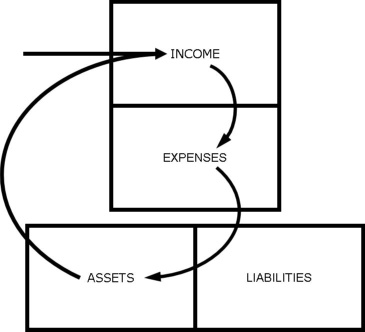
- Purchase an asset.
- Invest in the asset until it begins to generate its own money.
- Reinvest the money back into the asset to increase its value.
- Repeat the process until the asset or combination of assets are generating enough money to finance a lifestyle.
What is an asset?
Anything that puts money into your pocket.
Many adults believe an asset costs a gazillion dollars; I want to disrupt that thought with some facts.
The internet and other software technology allows anyone to purchase or build income generating assets,
starting with less than $100. Beginning with a small investment is an excellent opportunity to practice the 4-steps.
What is a liability?
Anything that takes money out of your pocket.
Non-income producing; cars, real estate properties, Jordan's, and items like these are all liabilities.
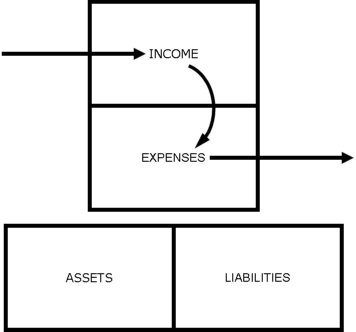
Cashflow diagram of employee.
Cashflow diagram of the financially literate.
The 7 Rules of Money,
- Save Money
- Control spending
- Purchase an asset (what the savings are used for)
- Find a mentor to help guard your treasure against loss.
- Own your home and treat it as an investment that will appreciate.
- Ensure a future income with evergreen skills.
- Increase your ability to earn.
Rules 1 & 2 require self-discipline. to help you we offer: Personal Transformation Mastery,
the Member's area where you can also find simple, actionable steps that will guide you through Rules 3-7
The 3 Types of Income and How to Use Two To Acquire the Third
Active income - money earned as an employee or self-employed business owner.
Save a portion of wages to invest in an asset that leverages the time and efforts of others to generate money.
Follow steps 3-7
Leveraged income - income earned from leveraging the time and efforts of others, as an insurance broker or real estate broker
leverages the time and efforts of an army of agents. Dedicate portions of earned income to invest in assets that doesn't require
physical presence or active participation to generate money. (eg real estate, minerals)
This becomes a
Passive income - income that shows up in your bank account that required no active participation to earn.
The 2 income generation strategies,
Strategy #1 - an employee who trades time for an hourly wage (needed for the monetary system to work).
Strategy #2 - an entrepreneur who leverage systems and the efforts of employees to generate an income.
The monetary system rewards one strategy and penalizes the other. When greed is not involved, I never have enough money and
I never have enough time issues are typically the result of applying income strategy #1.
Extreme examples of the formula,

Here are the 4 richest today. The positions can change overnight.
https://www.forbes.com/real-time-billionaires/
If you want the list up to date
What do these 4 men have in common aside from obscene amounts of money?
I want to direct your attention to the "SOURCE" column (as in source of wealth) on the Richest Man list above.
Notice they all sell a product or service using a business model.
If one man has the knowledge it can be taught.
No one is born pre-programmed with this type of knowledge, it had to be learned somewhere.
If you didn't know before your arrival, this is where you learn it.
Recommended Reading
Rich Dad/Poor Dad
Cashflow Quadrant
The Richest Man in Babylon
Supplementary Reading
Creature From Jekyll Island